Showing posts with label SCVMM2012. Show all posts

Tuesday, August 13, 2013

Storage Discovery scope is greyed out - VMM 2012 SP1

When you try to add a storage device to VMM 2012/2012 Sp1, you cannot get past the ‘Specify Discovery Scope’ screen.
You will by default have protocol SMI-S CIMXML, but are unable to change this as well as the TCP/IP port, which is currently locked at 5989.
The options to change one of these, are greyed out.

To fix this, please remove the following KB:


Friday, May 10, 2013

Intelligent Placement and Dynamic Optimization in VMM 2012 SP1

This blog post will cover what Intelligent Placement is in VMM 2012, how it works and how it fits into Dynamic Optimization.

High-level overview of Intelligent Placement

When you deploy a virtual machine with VMM, there is a lot going on under the hood to ensure that you will have a successful deployment. Things like hardware configuration and host resources is critical, and also consistency when you deploy to a cluster. In summary, there is a lot of variables in the mix that can give you a warning or error. Some of the warnings and errors you might get could seems irrelevant to you at first, but VMM like to ensure that your environment is fit, healthy and properly configured.

 This is why I am writing this blog post to enlighten you to be able to understand what is going on and how to correct these things. I’ve seen a lot of consultants, customers and forum users blaming VMM for not being able to deploy a virtual machine, while it is successful when using Failover Cluster Manager or/and Hyper-V Manager.

Virtual Machine Manager – The Management layer and its intelligence

Once you add your virtualization hosts (Hyper-V) to VMM, the VMM agent gets installed as part of the process.

The VMM management server communicates with its agents on the hosts and get the information its need to detect how the hosts are operating. The Fabric workspace in VMM is where you configure your infrastructure – the building blocks for your datacenter and cloud. This will include storage, network and computing power. Computing power in this context is equal to virtualization hosts and the different server roles required supporting their life cycle. You can configure Host groups within VMM and the host groups contain several properties for the hosts it contains.

One of the properties that is relevant to this blog post and intelligent placement is host reserves and dynamic optimization.

You can specify an amount of resources that should be reserved for the hosts within the host group at all time. VMM will bring this (among other variables, as we will see) into consideration during deployment of virtual machines and services. And just to be a bit more complex, you have the opportunity to specify host reserves on each host individually as well. As you can see, there is a lot of things to be aware of. Someone should keep this in mind all the time. There might be just you that is deploying virtual machines in your organization, or other administrators as well. Luckily, VMM is our rescue here and keep track of this all the time.

Networking is another major factor that may affect the deployment. This is also something you map to your host groups, so that VMM is able to tell if a virtual machine can be deployed to these hosts or clusters and ensure network connectivity.

Imagine this in a huge environment. You would probably need a couple of spreadsheets to keep this documented, and remember you would have to maintain it too.

Dynamic Optimization

When you have a cluster managed by VMM, you can enable both Dynamic Optimization and Power Optimization at the host group level. Dynamic Optimization will load balance the cluster(s) when enabled, based on the configuration you specify. You can decide how aggressive it should be (move virtual machines for less gain) and how frequently the optimization should run. Power Optimization will power your hosts on and off when needed, to support the workload. Power Optimization requires Dynamic Optimization to be enabled and that your hosts are configured for out of band management.

Dynamic Optimization is one of the features you should really care of if you want to enable a private cloud and have a dynamic environment for your virtual machines. Instead of check the state of your cluster, hosts prior to a new virtual machine deployment, make sure you have enough resources; VMM will do this for you thanks to intelligent placement, and ensure that the environment is correctly balanced with dynamic optimization.

Dynamic Optimization was first new in VMM 2012 and did not require SCOM integration to work, as it required in VMM 2008 R2.

So instead of using a SCOM agent on your hosts to get this information, VMM monitors and acts natively in the VMM service with the VMM agents instead and relies on the intelligent placement feature.. Since VMM is now in control of it, you will have a centralized decision maker seeing your cloud fabric in context.

We now know that Intelligent Placement is the enabler for Dynamic Optimization and you should really use Dynamic Optimization (and eventually Power Optimization if possible) when managing your cloud environment. We will now have a look at some of the checks that intelligent placement is doing for you

What does Intelligent Placement actually check before it places its virtual machines on the hosts?

Platform type (Hyper-V, XenServer, VMWare)
Three different hypervisors is potential equal to three different kinds of errors.
Hyper-V has its own disk formats and scalability limitations, and the same goes for both VMware and XenServer. If you try to deploy a virtual machine with VHDX disks to an ESXi host, or trying to deploy a VM that has Dynamic Memory enabled when the hypervisor does not support it, this would fail beyond recognition. Intelligent Placement will check this, and you can create hardware profiles for your virtual machines that matches the three different hypervisors that VMM supports and categorize these in the library.

CPU compatibility
Make model, stepping and architecture.
A known rule in the Hyper-V world is that you can perform Live Migration between hosts as long as the CPU is from the same manufacturer. You can also enable the option to allow migration to different CPU architectures on the HW profile for the virtual machine. This is something that VMM checks for you during deployment and intelligent placement.

Host Reserves
As mentioned earlier, each host group and each individual host can have its own reservations. Intelligent Placement will ensure this will be considered during placement of VMs so you do not overcommit your hosts and clusters. 

Logical processor count on the host
With Hyper-V in Windows Server 2012, you can have as many vCPU’s within a virtual machine as there are logical CPU’s on the hosts. The maximum number a virtual machine supports is 64 vCPU’s.
To summarize, if you deploy a virtual machine with 14 vCPU’s and the host only has 8 logical CPU’s, this will result in an error telling you what is going on and why it is failing.

NUMA configuration match between VM and host
VMM detects and check the NUMA configuration to make sure nothing is in disharmony before it deploys a virtual machine.

Snapshot compatibility
Compatibility on migration or deployment from libraries will be checked during intelligent placement.

Host state
Checks if the hosts are available for placement, responding, has healthy agents and so on.

Networking
This could probably be an entire blog post by itself. Networking plays a huge role in VMM, and VMM is responsible and able to ensure that everything is properly configured. Network connectivity for the hosts groups, associated physical network adapters on the hosts to the right logical networks, VM networks associated with the right logical networks according to the host groups and hosts, if network virtualization is enabled on the logical network and/or the logical switch, native port profiles, if the load balancer is available for host group and much more is checked both during placement and during Dynamic Optimization.

Possible owners, preferred owners (Cluster)
Now in VMM 2012 SP1, you can specify both possible owners and preferred owners for each virtual machine. This is a setting we know from Failover Cluster in Windows Server and VMM and these settings are now exposed in VMM. VMM will bring this into consideration during placement and when Dynamic Optimization kicks in.

Availability sets and Anti-Affinity settings
When you configure availability sets for the virtual machines, VMM will not place these virtual machines on the same hosts. Please note that this is not a hard block.

Machine name length
Allowable characters in VM name per platform.

Allowable characters in VM name
This setting is individual to each platform.

Disks
Disk matching, space, classification, disk IO capacity, shared disk type, and pass-through disk checks.

Cluster overcommit checks
VMM can configure ‘cluster reserves’ for each cluster. If the value results in overcommit for your cluster, you’ll get a warning during placement, and dynamic optimization might not run as expected.

RemoteFX
Checks if RemoteFX is available on the hosts compared to the VM configuration

Each of these checks is taking into account on every deployment, migration, dynamic optimization, maintenance mode and is continually evaluated by intelligent placement so that the appropriate actions can be taken if there are any problems.

I would like to thank Hilton Lange on the VMM team for providing me with valuable insight and tips to create this blog post. Thank you!

There is a lot more going on, and I will likely be updating this blog post when something new is added – or detected on the way.

Tuesday, December 18, 2012

VMM doesn't show hosts performance


.... or Hyper-V doesn’t report performance to VMM.

One of my customers where having some issues in their development environment today, using Hyper-V in Windows Server 2012 and System Center 2012 SP1 Virtual Machine Manager (BETA).
The issue was that in the VMM console, the performance view was static, and didn’t show any changes at all.

Since I have some experience with SQL servers over the years, I was guessing there was something wrong with the performance counters on the hosts itself, since everything else was working as expected (all management operations initiated from the VMM console).

How to rebuild the performance counters in Windows Server

Open a command prompt (Run as Administrator) and fire the following commands:

1)      Lodctr /R (this will resbuild the perf counters from system backup store)

2)      Winmgmt /resyncperf (this will register the system performance libraries with WMI)

The last thing we did, just to have everything straight, was to reinstall the VMM agent on the hosts.
Remove - and add the hosts to a host group in VMM.

Once this had completed, VMM reported hosts performance as expected.

Tuesday, April 17, 2012

Understanding Microsoft Private Cloud - White paper

I`ve created a tiny white paper that explains cloud computing in general and the value that System Center 2012 brings to the table.
Based on research and work I`ve done over the last year, there is a huge need of knowledge and understanding of the subject. And it`s very important to know what cloud is, and how Microsoft offer cloud computing through System Center 2012 prior to the deployment.

Hopefully, this document will provide you with an overview and introduction, targeting both the CIO and the IT-pro.

Download the white paper here!

Cheers,

Monday, February 20, 2012

SC 2012 Integration Packs - VMM

What do you get if you give steroids to the Windows Task Scheduler?

-          System Center Orchestrator


Orchestrator empowers IT pros as well as developers to easily develop Runbook that interoperate with 3rd party systems to automate datacenter workloads. With a simple drag and drop interface, you`re able to do whatever you want, and a little bit more.

System Center 2012 will play a major role for the IT pro, and Orchestrator will be another mind shift in the cloud stack, with reference to automation and best practice.

Orchestrator includes over 41 built-in workflow standard activities that perform a wide variety of functions and tasks. For the integration with 3rd paty platforms and products, and of course also Microsoft products, you can install integration packs (IPs) which will contain additional activities that extend the functionality of Orchestrator.

To summarize: System Center 2012 – Orchestrator is the glue in your private cloud.


How to register an Integration Pack

After the download, you have to register the IP with the Orchestrator management server and then deploy it to a runbook server that has the Runbook Designer installed.

1.       Start the Deployment Manager, expand Orchestrator Management Server, right click Integration Packs to select Register IP with the Management Server. This will start the Integration Pack Registration Wizard. Click Next.


2.       In the Select Integration Packs or Hotfixes dialog box, click Add, locate the .OIP files, click Open and then Next. Finish the wizard and accept the End User Agreement (after you`ve read the Microsoft Software License Terms)


How to deploy the integration pack

1.       In the very same Deployment Manager as mentioned above, righ click Integration Packs and click Deploy IP to Action Server or Client. Select integration packs you want to deploy and click Next. Enter the name of your runbook server, add, and click next.


2.       Choose a time to deploy, select Schedule Installation and finish the wizard. If you don`t schedule an installation time, the IP will be deployed immediately after the wizard.

 Getting started with the VMM IP

1.       Logon to your runbook server and click Options and SC 2012 Virtual Machine Manager


2.       Type a name for the connection and select the proper type (in this case, Virtual Machine Manager).


3.       Configure the connector by specifying VMM configuration data and authentication. (Make sure that you have configured the authentication you choose in your environment prior to this, or else it might fail).


4.       Once this is done, you have several new options to the right in the Runbook Designer.


5.       Have fun!


Thursday, February 9, 2012

Getting started with Services in VMM 2012

Dear community,

If you`re not familiar with Services in VMM 2012, I have created a tiny document where I`m trying to explain it a bit with my own words and by using a visual guidance.
Hopefully some of you will find it useful.

Download / view it from here: Getting started with Services in VMM 2012

Cheers.

Monday, February 6, 2012

Microsoft Private Cloud Book


2011 was such an exciting year. I became a Microsoft MVP the 1th July, and also published my book later that year. Of course it was about Cloud Computing – using Virtual Machine Manager 2012 (written in Norwegian).

A couple of weeks later, I received one of the best e-mails ever. From Mr. Aidan Finn!
And the CC`s on that mail, were the likes of Hans Vredevoort, Damian Flynn and Patrick Lownds.
They informed me that they were working on a book. “Microsoft Private Cloud” – focusing on Virtual Machine Manager 2012, and they needed a technical editor.
To get quickly to the point: I did not hesitate a single moment, and was happy to confirm that I would accept this great honor.

So my job with this book is related to review the technical content and make suggestions where it`s needed. Actually, this is a luxury job. With so many skilled authors and technicians on the team, you should prepare yourself for a really good, technical and academically compelling book, covering all the details you would require to be successful with your private cloud implementation.


Wednesday, January 25, 2012

The real deal - Services (Part Two)

If you have tested the deployment of services in VMM 2012, you`re most likely familiar with the Stock Trader Service. You`re able to import this service into your VMM Library. (Check this blog post)
Instead of just deploying this service and show you some screenshots, I`ve de-coupled the service so I`m able to create it from scratch using VMM 2012 and explain the details and see how the Stock Trader service is built and designed.
Remember that VMM 2012 has native support for Web applications, Server App-V applications and SQL data-tier applications.

Creating and deploying a multi-tier service

Let`s pretend that we`re working close with some of our developers and actually know how this application is meant to work.

We also know that this application would require a SQL database server, two middle-tiers and a web-tier. The web-tier should also be able to scale out since it`s stateless and would therefor need a load balancer.

Step 1 – Creating the VM templates

The big hitch in cloud computing is the software dependencies. But with VMM 2012 you`re able to have loosely coupled services like web applications and Server App-V applications. To summarize, you only need a sysprep`d VHD with for example Windows Server 2008 R2 installed.

The SQL Database server requires a Microsoft SQL Server and VMM supports SQL Server Profiles in the Library (containing SQL configuration, service accounts, defines SQL Authentication or/and Trusted Authentication, installation media, TCP/IP and Named Pipes ++) which means we can deploy SQL server as part of our service during the deployment. However, the VHD-file that is used must be sysprep`d with a sysprep`d SQL server as well. (Check this blog post)

To summarize again: Sysprep 2 Windows Server 2008 R2 VM`s where one of them also have a sysprep`d SQL server. Right click your VMs in the VMs and Services view in VMM and click ‘Create’ and ‘VM Template’. VMM will now sysprep your VMs and place them in the library share that you specify.



Step 2 – Preparing the applications

Ok, our developers have sequenced the applications for our middle-tiers by using Server App-V.

If we take a closer look at the packages, we can explore the manifest.xml-files.

These files will show which server roles, server features and any other components that`s required for our VM template to work. The good news is that VMM is able to detect this when you add the application to the template.

Tip: if you know exactly what you`re doing when you`re sequencing your applications, you can have a package ready in a couple of minutes and you`re good to go. However, you`ll most likely have to test the sequencing process again and again and again to be sure that you have done everything correctly. In some cases, your applications are not suited for the Server App-V. But since this would require some testing (I guess) you should create a VM, install the Server App-V sequencer agent – which is included in your VMM setup and available in the library, and use checkpoints/snapshots during your testing. This is a scenario where snapshots are very neat and helpful.

VMM also includes WebDeploy so that you easily can import web applications to your IIS servers. For more information about WebDeploy, click here.

Basically, you install the WebDeploy kit on your web servers, export the application in IIS, and then you`re able to import these applications in to another web server (IIS). In some cases, you can also virtualize these applications by using Server App-V.

Our applications would also require some data-tier applications as well, and VMM has support for this too. A data-tier application (DACPAC) is an entity that contains all of the database and instance objects used by an application. A DAC provides a single unit for authoring, deploying and managing the data-tier objects instead of having to manage them separately. A DAC allows tighter integration of data-tier development with the development of the associated application code. It also gives administrators and application level view of resource usage in their system.

You can extract the data-tier applications by using SSMS 2008 R2.

For more detailed information about SQL data-tier applications, check this site.

Step 3 – Working with Application Profiles

Some new improvements in VMM are related to the Library. When it comes to your applications, you can create application profiles that are loosely coupled with your virtual machines, so you`re able to use them over and over again, with no need for sysprepping your VMs with the applications already present and installed.


Your application packages must be stored in the library and indexed by VMM. The default refresh interval is set to 1 hour but you can do this on demand manually by right clicking your library server/share and click refresh.

So since the service we`re about to deploy is based on the native applications that VMM supports, we will create some application profiles that will install the Server App-V agent and WebDeploy.

WebDeploy and Server App-V is stored default in the library, and when you add a new library server, you have the option to import the default Application Frameworks into the library (which contains Server App-V sequencer and agent, WebDeploy and scripts that would install this automatically during service deployment.

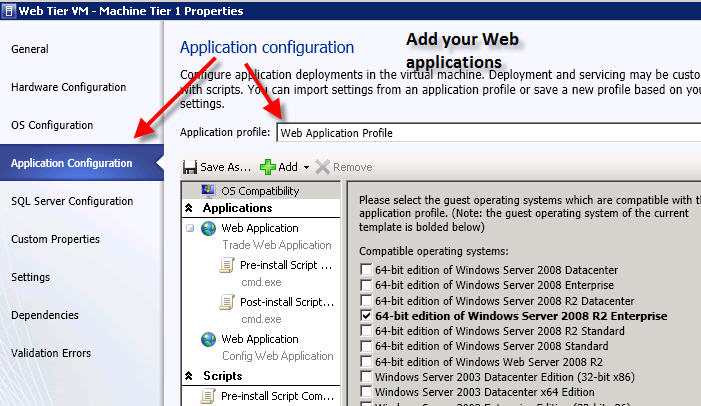
To install these components, you must add a script to the application profile.
Since you would require either WebDeploy or Server App-V agent to be installed prior to the applications, you would normally create a Pre-install script.
Specify the executable and the parameters, and browse to the package located in one of your libraries. Select a Run as Account with proper permissions to install the package in the virtual guest OS.
In addition, you can specify advanced scripting logging for troubleshooting in case the deployment fails.


Once this is configured, you may add the applications and applications scripts required to get the applications up and running. It really depends which application you`re dealing with, and you should work closely with your developers/application owners to get this correct, and fill in the required parameters and instructions for the installation of the applications.

The example above shows the deployment of WebDeploy and a web applications with application scripts.
The same rules apply for the Server App-V applications and SQL data-tier applications.  

Step 4 – Working with the Service Template Designer

We`ve now got our application profiles and the VM templates configured and stored in the Library.
Navigate to the Library workspace and select Service Templates, right click and click Create Service Template.

This will launch the service template designer.

VMM ships with some patterns to get you started really quick. Either a single-tier template or a multi-tier template.

We will start from scratch in this example.


As you can see, you can drag your VM Templates into the designer. We need four VMs for this service, and will therefor use a VM template which contains the sysprepped SQL server, and an empty sysprepped VM for the rest of our tiers.

Let`s start by configuring our SQL Server VM.

This tier would require a SQL server and the SQL data-tier applications. From the service canvas we`re able to click on the ‘Add application’ button and select profiles and applications from our library. (You can also configure the HW and OS profiles for your VMs – directly from this view).

Now, let`s do the same for our middle-tiers and add the Server App-V applications

Now, we have to add our web applications to our web tier.
Since our web-tier should be able to scale out, we must also configure a load balancer. The good news is that Microsoft NLB is integrated into VMM by default, and the only thing you have to do is to create a VIP Template. In this example I`ve created a HTTP VIP Template and associated it with the NLB load balancer in Network in the Fabric view. Once you have done this, you only have to add the NLB feature in the OS configuration on your VM template – along with any other required Web-roles/features to get your web-tier up and running.

VMM knows immediately that this tier should be able to scale out, and during the deployment installs and configure NLB automatically, after you have added the load balancer into the service canvas and defined the connectivity, and set the scale limit.


After you have added all the required profiles, applications and configured the VMs, you should ask yourself: how would I normally deploy this service if I did it manually?

Eventually, this leads us to the Application Deployment order.
In this example, I want my SQL server to be deployed first so it`s able to receive connections and data from the other applications, since they rely on this tier. Second, I want my web-tier to be deployed, and my mid-tiers as number 3 and 4.

Once you have configured all this and feel quite satisfied, you can save and validate the configuration. If there are any errors related to the configuration, VMM will notice you before you go any further.
If everything seems fine, click Configure Deployment, give your service a name and place it either on a host group or a private cloud.

Once you click ‘OK’, intelligent placement will kick in and check where the service should be able to run. If everything is OK, you can start the deployment of your service.

I will most likely create a webcast that demonstrate the entire process in the near future. Please give me a note if you have any questions etc or want me to cover.

The next blog post will focus on the service lifecycle in VMM.

Monday, January 23, 2012

The real deal - Services (Part One)


I was wondering if I should try to create a white paper about «Services» in VMM 2012. But I found out that a bunch of blog post would be more suitable, and also less formal than a white paper.

What is a Service?

From the early beginning of Microsoft Private Cloud, they stated very loud and clear that they were able to focus on the real deal, - services.

If you`re familiar with Windows Azure, you may recognize the term ‘Service’ as in hosted services in the Windows Azure portal. It can be a VM Role, Web Role or a Worker Role. But that`s for Azure. There are some architectural differences between the service concept in Microsoft Private Cloud (VMM) and in Microsoft Public Cloud (Windows Azure).

Let`s talk shortly about both of them before we go any further.

In Windows Azure, you can create hosted services. These services are created in Visual Studio 2010, and as mentioned earlier, either a VM Role, Web Role or a Worker Role. For the Web and Worker Role, you`ll get a configuration file and a package. Upload these files to the Windows Azure portal (or you could simply use System Center App Controller for that) and you`re good to go. Prior to this, you must have signed up and created a Windows Azure Subscription.

The beauty of the Platform as a Service model is that Windows Azure will take care of everything. Define how many instances you`d like and Azure will configure the required VMs, and eventually place them behind a load balancer and a VIP template.

-          Ok, brilliant. But what about the storage?

That`s a very good question Kristian.
When you`re working with Windows Azure – think stateless, stateless and stateless. Also when it comes to the VM Role. You should use one of the storage options in Windows Azure, and there`s several options here as well. Binary Large Objects (Blobs), Queues, Tables and SQL Azure. Now, if you plan for a massive scalable storage solution, use Blobs. This is the cheap storage solution for you hosted services, and if you`re creating an application that will not update the content quite frequently, you can also take advantage of the Content Delivery Networks (CDN) – so that you`re closer to your users, which gives them a better user experience. If your applications require some sort of relational data storage, use SQL Azure.
That was a really short summary of the service architecture in Windows Azure.
And since I`ve got your attention: if you`re an ISV and have not considered Windows Azure as a platform for your developer projects in the future: shame on you. J

In the private cloud where Virtual Machine Manager 2012 plays the most important role, there is also a service concept.
Actually, I`ve blogged about this before. Get a quick introduction by reading this post first: http://kristiannese.blogspot.com/2011/07/understanding-service-concept-in-vmm.html

Welcome back.

As you can see, there are some similarities in both clouds. Reminder: think stateless!

If you plan to scale out, scale out the tiers that`s suitable for this scenario. Stateless!

In VMM 2012 – you can create Virtual Machine Templates, but also Service Templates. A service template is the starting point for your services where you configure virtual machines and connectivity requirements. The service template is more than just a template, because VMM is able to support the life cycle of your applications. So every deployed services are always linked to their templates so you can do servicing of the instances.

Now, what`s an instance?

An instance could be groups of machines that work together which includes machine definitions as well as applications. There is support for these native applications types in VMM: Web Applications (WebDeploy), Virtual Applications (Server App-V packages) and Database Applications (SQL DAC). You can create application profiles in the library so that you can use them over and over again.

For more information about the new improvements in the library of VMM 2012: http://kristiannese.blogspot.com/2011/04/sorting-things-out-in-library.html

So before we go ahead and look closer at the service concept in VMM 2012, why would you consider using services in the first place?

A service can be a single tier service or a multi-tier service. And you are able to configure and manage multi-tier applications as a single entity.

Example, you may have an application that your organization has developed, or you are testing and doing some research on an application from a software vendor. Anyhow, this particular application is comprised of a web server, a database server and an application server which should be considered as critical for your business. Call it a line-of-business application – the one that your CEO really cares about.

Since this one is important, you want this application to be alive and kicking 24/7 – no matter what happens related to traffic and peaks. VMM enables you to handle fluctuations in capacity for your application, allow you to easily add or remove virtual machines (hey – please think ‘stateless’) needed to support the application.

This is the beauty of cloud computing, the cloud workload patterns:


The next blog post will discuss the service designer in detail.

Cheers,

Thursday, January 19, 2012

Sessions from NIC 2012 – now available

As I recently wrote earlier this week, the NIC conference was held for the first time in January 2012 here in Norway in Oslo Spektrum.
I had 2 sessions, one session where I explained Cloud Computing and especially the Private Cloud, and one session where I introduced System Center App Controller with the cloud, explaining the service concept in both VMM 2012 (Private Cloud) and Windows Azure (Public Cloud).

You can watch the “App Controller session” here: http://vimeo.com/nicconf/review/35056290/3bbb35aab9

I will post my Private Cloud session once it`s available.

Wednesday, December 21, 2011

Required Management Packs for the Cloud Process Pack


Required Management Packs for the Cloud Process Pack

Ok, I`ve done this a couple of times no, so I want to share it.

First you make the SCVMM/SCOM integration (http://kristiannese.blogspot.com/2011/12/integrate-scvmm-2012-with-scom-2012.html ) and import all the required management packs in that process.

Once this is done, you have to import several management packs into System Center Service Manager 2012 before you`re able to install the Cloud Process Pack.

Tip: Download all management packs with Operations Manager to a folder, and import the following management pack to Service Manager 2012:

·         Microsoft.SQLServer.Library.mp

·         Microsoft.SQLServer.2008.Monitoring.mp

·         Microsoft.Windows.InternetInformationServices.2003.mp

·         Microsoft.Windows.InternetInformationServices.2008.mp

·         Microsoft.Windows.InternetInformationServices.CommonLibrary.mp

·         Microsoft.Windows.Server.2008.Discovery.mp

·         Microsoft.Windows.Server.2008.Monitoring.mp

It`s important that you import those MP`s above prior to the MP`s below, since many of them have these as requirements

In Service Manager 2012, import all the management packs from these locations:

·         From your SCVMM install: %Programfiles%\Microsoft System Center 2012\Virtual Machine Manager\ManagementPacks

·         From your Service Manager 2012 install: %Programfiles%\Microsoft System Center 2012\Service Manager 2012\Operations Manager Management Packs

·         Also from your Service Manager 2012 install: %Programfiles%\Microsoft System Center 2012\Service Manager 2012\Operations Manager 2012 Management Packs