Showing posts with label SC 2012 SP1. Show all posts

Wednesday, January 2, 2013

New job - CTO at Lumagate

"New Year, new wife, new job and new shoes. "

To all the readers of Virtualization and some coffee: Happy new year!

I appreciate that you are reading my blog posts and get in touch with me whether it’s just a question or you want to discuss something more in detail.

This is the year we have been waiting for, us that’s working in the Microsoft cloud space.
Windows Server 2012 is up and running, and now SP1 for System Center is knocking on our door.
Maybe we can take a short break soon?

Fortunately, we can’t. It’s time to get down to business and execute all the promises we made prior to SP1.

This is the ship – and we are sailing right now.

And that, my friends, is the main reason why I’m starting this year in a new job.

I have joined Lumagate, a System Center specialist in the North focusing entirely on System Center, as the Chief Technology Officer.

As a CTO, I will drive our dedication to System Center further, and have a wide diversity of responsibilities. Like business development, working on large projects with key customers, pre-sales, POC’s, workshops and internal training. I will have the best and brightest consultants under my wings, ready to deploy world class System Center solutions, addressing each and every challenge related to datacenter and cloud management, and clients too.

Last year (2012) I worked for Microsoft as an Infrastructure Ranger. I will still continue to work closely with the local MS office, but as a partner and vTSP.

I am really looking forward to start in this job and be as technical as possible so I can stimulate my own needs, and the community.

Speaking of community: NIC 2013 is about to start, and I will have three sessions.
I am currently working on a freshly installed lab, running several Hyper-V clusters and System Center 2012 SP1.
While working on the setups, I thought I should document something useful as I am preparing a ‘Configuring and Deploy the Microsoft Private Cloud’ session for NIC.

Next blog post will be focusing on Fabric configuration with Microsoft technologies, prior Win 2012 and Post 2012.

Wednesday, October 24, 2012

SQL 2012 AlwaysOn + IP for Azure in Orchestrator 2012 SP1


Just a quick heads up for something interesting in this blog post.

1.       Learn how to configure SQL 2012 AlwaysOn for your VMM 2012 SP1 database


2.       Download and test the Integration Pack for Orchestrator 2012 SP1 that let you manage your virtual machines, services etc in Windows Azure.


Overview

​The Integration Pack for Windows Azure enables you to automate Windows Azure operations related to certificates, deployments, hosted services, storage, and virtual machines.

Feature Summary
The Integration Pack includes the following activities:

  • Azure Certificates- the Azure Certificates activity is used in a runbook to add, delete, and list management and service certificates
  • Azure Deployments- the Azure Deployments activity is used in a runbook to create, delete, get, and swap deployments, change deployment configurations, update deployment statuses, rollback an update or upgrade, get and change deployment operating systems, upgrade deployments, walk upgrade domains, and reboot and reimage role instances
  • Azure Cloud Services- the Azure Cloud Services activity is used in a runbook to create, delete, and get cloud services, check cloud service name availability, and create affinity groups
  • Azure Storage- The Azure Storage activity is used in a runbook to create, delete, update, and list storage accounts, get storage account properties, get and regenerate storage account keys, create, list, and delete containers, and put, copy, delete, list, snapshot, and download blobs
  • Azure Virtual Machine Disks- the Azure Virtual Machine Disks activity is used in a runbook to add, delete, update, and list virtual machine disks and virtual machine data disks
  • Azure Virtual Machine Images- the Azure Virtual Machine Images activity is used in a runbook to add, delete, update, and list virtual machine operating system images
  • Azure Virtual Machines- the Azure Virtual Machines activity is used in a runbook to create virtual machine deployments, download virtual machine remote desktop files, as well as get, delete, start, restart, shutdown, capture, and update virtual machine roles


Monday, October 22, 2012

Working with runbooks in Orchestrator


Working with runbooks

With the new kind of science, which you get from Orchestrator, people are often amazed when they see this engine in action for the first time.
It’s a standard reply to all questions related to Orchestrator, and that is ‘yes’. Your imagination is the limit.

In this blog post, I will show to simple runbooks that does something you might find boring and repetitive if you are working as a sysadmin today.

The first runbook will create a new user in my Active Directory domain, and enable the account.

The second will create a new virtual machine in my cloud.

Yes, as I said. Two very simple runbooks. Although you can create workflows that integrates all from hardware, software – and even human resources, it’s often best to start with small chunks to remove the typical tasks that you’re not paid for anyhow. You should be focusing on much more important tasks than these two, but that would be the next phase.

Background:

System Center 2012 has a component called Orchestrator. This is the glue in the System Center stack, orchestrating the most simple – and also the most complex tasks in your environment. The workflows that you create could be a combination of activities and scripts, running on your terms.

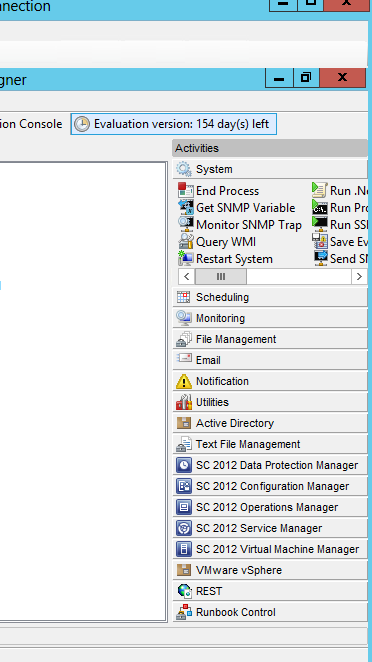
Orchestrator has a bunch of existing activities when you’re opening the runbook designer for the first time.

If you take a closer look at the picture, you will also find well-known Microsoft products and components as well as third parties. System Center 2012 has activities to each and every component, so that you can create extended functionality in your infrastructure, as well as automated tasks initiated by your users and customers, in conjunction with Service Manager’s self-service portal.


If you look closely, you can also see that I have imported an Integration Pack that integrates with VMware. But that’s another blog posts, and most likely it’s written by someone else.

Creating runbooks

Create a new Active Directory user

There are several ways to create runbooks. Some runbooks could be solely dedicated to system tasks, that runs either on a schedule, or is initiated by some system events and so on.

But if you want to create a runbook that should be presented to their users through some self-service mechanism, you would normally follow these steps:

1.       Initialize data

This activity will let you define parameters/inputs with different data types. For example, a user can specify user name, display name and other related information for a user object in Active Directory that will flow over the data bus to the next activity, which actually creates a new user based on the input in initialize data.

2.       Leveraging the activities from Active Directory Integration pack, will let you mix and match the most common tasks you would normally do manually. In this example, we will use the activity called Create User. The activity is connected to a domain controller in your environment. This is something you configure in the runbook designer itself, and also on each activity. The activities have several options related to them, and you can also add extras if you’d like. So the questions is: How can we get the data from the first activity and map them into the correct options in the next one?
 
In each option, you have the possibility to ‘subscribe’ on published data. Right click and click subscribe. This will let you map and address the data.  

3.       Enable the user is the last activity in this runbook. So once the user is created based on the input in the first activity, the account will be enabled.

Now, if you look at this runbook, you might think it’s simple, easy and not much of a hazzle to get things up and running.

However, I would like to stress that you should design your runbooks properly with some logging, alternative routes in case if an activity is failing and so on.

So let’s take a look at my second runbook.

Create a new virtual machine

We will start with the same task, initialize data. We want to combine this with a Service Offering in Service Manager, so that the users should be able to access this by themselves, with no need to access the actual management tools to perform this. (This is the beuty of self-service).

1.       Initialize data

I want my users to be able to create and deploy their virtual machines by themselves, without having the IT organization to interact each time. In addition, this must be as simple as possible, where the users have no idea of the underlying resources, or where it’s actually placed.

The only thing they should determine, is the name of the virtual machine – so that they can recognize it afterwards. 

2.       Create a VM from Template is the activity I will use. I have already create the sysprep’d VM, stored it in my library, and associated some profiles to make this magic happen.

3.       Start the Virtual Machine is the last activity, so they will be able to connect and access their resources once it’s comlpeted.

Again, a very simple runbook. But if you take a look at the data buses in this workflow, you can see I have differentiated them by using different colors. The blue ones are representing the data buses that went ok, and the red ones are related to errors.

To summarize, in case of an error during the process, the runbook will head over to the activity called ‘Send e-mail’ to notify some admins about what happen.

Hopefully, you got some ideas on how to get started with Orchestrator by now.

Use your imagination and try to start with the most boring tasks first thing first.

Next time, we’ll see how we can take this a step further with Service Manager.

Monday, September 10, 2012

System Center 2012 SP1 Beta is now available!


Oh yes.

Finally, System Center 2012 SP1 Beta is now available and this is the version that will work together with Windows Server 2012 RTM.


Windows Server 2012 and SQL Server 2012 Support
With this Beta release, all System Center 2012 SP1 components are now enabled to manage and run in a Windows Server 2012 environment.  System Center 2012 SP1 Beta also now supports the use of SQL Server 2012. 


Network Virtualization
With System Center 2012 SP1 you can take advantage of the Virtual Machine Manager’s ability to manage Hyper-V network virtualization across multiple hosts, simplifying the creation of entire virtual networks. 


Hybrid Cloud Management and the Service Provider Foundation API
System Center 2012 already enables optimization of your organization’s private cloud and Windows Azure resources from a single pane of glass, using the AppController component. In System Center 2012 SP1 we’ve extended AppController’s capabilities to include cloud resources offered by hosting service providers, giving you the ability to integrate and manage a wide range of custom and commodity IaaS cloud services into the same single pane of glass.


Service Provider Foundation API
The Service Provider Foundation (SPF) API is a new, extensible OData REST API in System Center 2012 SP1 that enables hosters to integrate their System Center installation into their customer portal and is automatically integrated with customers’ on-premises installation of AppController. A simple exchange of credentials enables enterprises to add the Service Provider cloud to App Controller for consumption alongside private and public cloud resources. SPF also has multi-tenancy built-in enabling operation at massive scale, controlling multiple scale-units built around Virtual Machine Manager.


Windows Azure Virtual Machine management
System Center 2012 SP1 now integrates with Windows Azure Virtual Machines enabling you to move on-premises Virtual Machines to run in Windows Azure and then manage from your on-premises System Center installation enabling a range of workload distribution and remote operations scenarios


Enhanced backup and recovery options
System Center 2012 SP1 Data Protection Manager adds the option to host server backups in the Windows Azure cloud, helping to protect against data loss and corruption while integrating directly into the existing backup administration interface in System Center. More details.


Global Service Monitor Support
System Center 2012 SP1 includes support for a new Windows Azure-based service called “Global Service Monitor” (GSM). GSM extends the application monitoring capabilities in System Center 2012 SP1 using Windows Azure points of presence around the globe, giving a true reflection of end-user experience of your application. Synthetic transactions are defined and scheduled using your on-premises System Center 2012 SP1 Operations Manager console; the GSM service executes the transactions against your web-facing application and GSM reports back the results (availability, performance, functionality) to your on-premises System Center dashboard. You can integrate this perspective with other monitoring data from the same application, taking action as soon as any issues are detected in order to achieve your SLA. To evaluate System Center 2012 SP1 with GSM, sign up for the customer preview of GSM.


Begin your evaluation of System Center 2012 SP1 with Windows Server 2012 today:

I will test and play with every component, but first thing first: Virtual Machine Manager.

Oh, and you will of course not be able to Live Migrate a running VM from your private cloud to Windows Azure. You will have to store it in the library and make it accessible for Azure before you can run it in Microsoft’s cloud datacenter.

Until next time,

Kristian

Thursday, July 26, 2012

Windows Azure Services for Windows Server - Part 2


In Part 2, we will take a closer look at the experience of this solution, already running in Windows Azure and the changes that were announced early in June. This is to help you to better understand Windows Azure in general, and to be able to use it in your strategy and also explain the long term goal of a common experience in cloud computing, no matter if it`s on-premise or public.

Windows Azure used to be PaaS – Only until recently.

I have blogged several times about Windows Azure and that it`s PaaS and not IaaS, even with the VM Role in mind.

A bit of history:

In the early beginning in 2007, Windows Azure did only support ASP.NET for the front-end and .NET in the back-end and was ideal for running Microsoft based code in the cloud and take advantage of Microsoft`s scalable datacenters. The only thing the developer had to focus on was to write code.

Based on feedback from customers, Microsoft had to open up a bit to support various workloads. People wanted to move to cloud computing but didn’t had the time or effort necessary to perform the transition. And of course, it was a huge question about costs as well.

In fact, If you needed to create a hybrid solution back then, you had to code everything. This also included the Service Bus for being able to communicate with on-premise resources or other roles in the cloud. Back in 2010 during PDC, Microsoft announced several new features like VM Role, Azure Connect and Admin mode among others.

Immediately people assumed that this was IaaS.

To make a long story short: Someone tried to move their VMs to Windows Azure (through Visual Studio, which they should consider as odd) and connected their VMs to on-premise resources by installing Azure Connect on their domain controller (also odd).

Things were running for a while, not fast as lightening but it did work, until Windows Azure did reset the image they uploaded. The reason for this was that the VM Role was stateless only.

The whole idea behind the VM role was to make it easier to move existing applications – that also required some manual configuration prior to launching the code for their applications. The developers knew this and was happy, but the IT pros who did misunderstand the concept, was failing beyond recognition. The really key to understand all this is to know cloud computing and its service models. PaaS is very different from IaaS when it comes to responsibility and functionality in the cloud stack. A rule to remember: if things are able to scale out, then it is stateless.

So what did change in June this year?

-        Windows Azure is now also considered as an IaaS cloud

When that said, the long term goal for your applications should be to be able to run in a PaaS environment which is considered as the most effective and modern pattern. But you have now an option for your server applications when using IaaS, since IaaS serves to the OS stack in the cloud stack. This means you can put whatever you want into your OS, and that IaaS is basically virtual machines – the most flexible service model in cloud computing.

Comparison of Virtual Machines (IaaS) vs. VM Role

Virtual Machine has persistent storage, included system partition

VM Role gives you a stateless VM with pre packed applications for advanced setup of applications

IaaS in Windows Azure introduces the following:

-        Support for key server applications

-        Easy storage manageability

-        High available features

-        Advanced networking

-        Integration with PaaS (as ‘Cloud Services’ in the new portal)

For us that have been working with infrastructure in general and private cloud, we know what this means. But we still need to dive into the PaaS offering in Windows Azure, although we’re not developers. The reason why I am saying this is because Windows Azure has a goal to deliver the same capabilities with their IaaS offering as with PaaS.
This will include things as VIP swap, fault domains and upgrade domains, affinity groups etc.

In the preview of the new Windows Azure portal you`ll find several images available.

-        Windows Server 2008 R2

-        Windows Server 2008 R2 with SQL Server 2012 Evaluation

-        Windows Server 2012 Release Candidate

-        Several versions of LINUX

Virtual Machine Architecture in Windows Azure

It was a question about storage for the persistent storage and Microsoft decided to used what they already had available in Windows Azure Storage, by leverage their Blobs which also creates at least three replicas. By using their existing Blobs in Azure Storage, they had to make several improvements for the overall performance as this was designed for PaaS. This has in turns lead to a greater performance for both PaaS and IaaS as a result of that.  (Amazon created a SAN solution for their VM storage).

You will find both Disks and Images in Windows Azure.

Image is a generalized VHD that you can clone and create VMs with.

Disks is the virtual hard disks associated with the VMs – as you already are familiar with through the concept of virtualization.

How many disks you can have attached to a single VM in Azure depends on the ‘VM Size’ like extra small, small, large and extrra large. The good thing though is that you only pay for what you are using (yeah, it`s cloud computing) so that every resources are dynamic.

By default, the OS disk in the VMs supports ReadWrite disk caching, and also ReadOnly.

The data disks supports None, ReadOnly and can be modified using ‘Set-AzureOSDisk’ or ‘Set-AzureDataDisk’ cmdlets. To connect to a VM in Windows Azure, you must use the ‘Connect’ button in the Azure portal to initiate a RDP session, and use the admin login you specified during creation. If it`s a Linux operating system you would use SSH to logon, that you installs on your client computer.

Cloud Service Architecture in Windows Azure

The concept of PaaS in Windows Azure is now called ‘Cloud Service’ and consists of Web Roles and Worker Roles which are running on VM instances.


In addition, when you create a stand-alone Virtual Machine in Windows Azure, it`s not bound to a cloud service. But when you are creating an additional VM you can then find an option to bound those VMs into a cloud service. So in other words, you can add virtual machines to existing cloud services.

Each cloud service has their own virtual private network where they can see each other and doesn’t have to communicate through the public IP/DNS name. The drawback for the moment is that it`s not possible that two different cloud services can communicate without going through the public IP/DNS name, but this is a feature that will come in the future. (Announced during TechEd)

Understanding High Availability in Windows Azure

SLA is an everlasting discussion between the vendor and the customer.

When we are talking about SLA we are always thinking about ‘how many nines do we need’. Windows Azure gives you 99,95% availability if you are following the rules and have at least two instances for your roles, and 99,9% for a single role instance.

We have something called Fault Domains and Upgrade Domains in Windows Azure.

Fault Domains represents hardware faults (rack) and default there is two fault domains for each role.

Update Domains represents how to service the roles during updates and default there is five update domains. You can create VM availability sets and spread the VMs on different fault domains

Windows Azure Virtual Networking

As I wrote in the beginning of this article, you could connect your cloud applications with on-premise resources by using Service Bus or Azure Connect. The last alternative was not ideal from an IT pros perspective, as you would have to install this agent on your domain controller. So let`s take a closer look at the enhancement in the networking space in Windows Azure.

You have now full control over VM names and can also take advantage of the Windows Azure provided DNS server, and resolve VMs by name within the same cloud service. If you want to be able to have name resolution between virtual machines and role instances located in the same virtual network but different cloud services, you must use your own DNS server (more about that in a later blog post).

One of the biggest benefit of Windows Azure DNS server is that you won’t get the degraded performance by lookup public IP/DNS when roles and VMs in the same cloud service must communicate, leading to fewer hops, since they are now communicating on the same virtual network, using internal IP`s/names.

As a ‘replacement’ for Azure connect, Windows Azure Virtual Network enables you to design and create secure site-to-site connectivity and protected virtual networks in the cloud.

Define your own address space for virtual networks and virtual networks gateways in the same manner as you would do when you`re working with branch offices.

We will not dive deep into all the details in this blog post, but you must take a moment and plan carefully when you are working with your network design, prior to publishing services and roles in Windows Azure. Consider the following:

-        DNS design

-        Address Space

-        Supported VPN gateway devices

-        Internet-accessible IP address for your VPN gateway device

And there`s more…
You can also take advantage of the new offerings like Web Sites and SQL Databases, and this will also be available in ‘Windows Azure Services for Windows Server’, but since this blog is mainly focusing on cloud computing and infrastructure, it will not be covered in this blog post.

Tuesday, July 10, 2012

Introducing SMB3.0 with Virtual Machine Manager


Virtual Machine Manager 2012 SP1 | Adding a SMB3.0 File Share to your Hyper-V Cluster

It`s been a long time since I`ve blogged detailed about Virtual Machine Manager.

I am a virtualization dude by heart, and I have spent most of the time on Hyper-V in Windows Server 2012 lately, and the rest of the components in System Center 2012.

But as we`re getting close to release of System Center 2012 SP1 (I guess, since Windows Server 2012 was announced to be RTM the first week in August today at WPC), it`s time to dive into the details once again.

Since there`s some major new features and changes in Windows Server 2012, and most of it is very tightly to the Hypervisor, we will see Virtual Machine Manager adopt these asap.

Today, we`ll take a look at the SMB3.0 protocol, and how it`s being used by VMM to create flexible Fabric solutions.

SMB3.0 

So what exactly is SMB3.0?

Server Message Block protocol operates as an application layer network protocol, for providing shared access to serial ports, printers and files. You have most likely been using this protocol for decades in your network. One of the good things with SMB3.0 in Windows Server 2012 is that you can now run virtual machines and SQL user databases from a SMB3.0 file share.

Needless to say, this will create some new options for your private cloud to host VMs.

And when we add Multi-channel and RDMA to the table, this will actually be able to scale out beyond traditional datacenter implementations.

To be able to scale out a SMB3.0 share, you would need a Failover Cluster with the SMB Scale Out File Server role. I will blog more about this in the future, but as an easy overview, the Hyper-V hosts will access the SMB share on the cluster, using every possible network route. This will also introduce us to something called CA – Continuous Availability – meaning no downtime for your VHDs.

Scale-Out File Server is designed to provide scale-out file shares for server applications.

Benefits of using Scale-Out File Server in Windows Server 2012:

Increased bandwidth by using the total bandwidth of all cluster nodes in the Scale-Out File Server Cluster. You`ll notice this during cluster creation when you add the Scale-Out File Server role, that you don’t assign an IP address to the cluster. You only define the subnet. This means that every possible route to the cluster will be used for maximum performance, and is quite simple, cheap and easy to scale out by adding more routes/servers/NIC`s.

This leads to the term “Active-Active file shares” since all nodes in the Scale-Out File Server Cluster can accept and serve SMB client requests, also known as Continuous Availability since this provides transparent failover during planned – and unplanned downtime.

Scale-Out File Server role is built upon Clustered Shared Volumes, meaning that you create your file shares on a CSV. This will also give some of the other new benefits like CHKDSK with zero downtime on your CSV (this is independent of the Scale-Out File Server role), without any impact on your applications. Another neat feature is the CSV cache for increased performance in your virtual environment, especially for VDI scenarios.

To summarize a bit before we focus on Virtual Machine Manager, we can recommend using Scale-Out File Server for the ability to scale in an easy, reliable, cost effective and reliable manner. It`s not recommended to use this role for workloads that generates a lot of metadata operations such as typical information workers. Think of it this way: If you have a large datacenter running many many many virtualization hosts and you would have to purchase a large volume of new virtualization hosts to respond to business requirements, and you`re using a FC SAN as storage. You would have to buy additional HBA ports for every single new host, increasing the cost additionally. If you had a SMB Scale-Out File Server Cluster, you would only need the HBA ports on these nodes, and could connect your virtualization hosts to the cluster using 10GBe.

You can easily set this up by using Failover Cluster Manager or Server Manager today, and point the locations for your VHD`s to be on this share in Hyper-V Manager, Failover Cluster Manager and Powershell.

But we will also need a solution on the management side. This is where Virtual Machine Manager comes handy.

A couple of important things to notice prior to adding your SMB share to your Hyper-V servers/clusters:


·    We recommend that you use a dedicated file server.

·    For SMB 3.0 files shares to work correctly with VMM, the file server must not be a Hyper-V host. This also applies to a highly available file server. Do not add the file server (stand-alone or cluster) as a managed host in VMM.

·    The file share must not be added as a VMM library share.

·    The VMM service account must have local administrative permissions on the file server where the SMB 3.0 share resides. You must assign these permissions outside of VMM.

·    If you used a domain account for the VMM service account, add the domain account to the local Administrators group on the file server.

·    If you used the local system account for the VMM service account, add the computer account for the VMM management server to the local Administrators group on the file server. For example, for a VMM management server that is named VMMServer01, add the computer account VMMServer01$.

·    Any host or host cluster that will access the SMB 3.0 file share must have been added to VMM by using a Run As account. VMM automatically uses this Run As account to access the SMB 3.0 file share.

Adding a SMB3.0 File Share to your Hyper-V Cluster

Navigate to your Fabric workspace in VMM and right click the Hyper-V Cluster you`d like to use a SMB3.0 File Share, and click properties.

Click ‘File Share Storage’, Add and type in the UNC path to your SMB share.

Once this is done, you should be able to specify the SMB share as the location for your VMs during creation.

You can also perform this task by using Powershell:

Example:
$hostCluster = Get-SCVMHostCluster -Name "hvcluster.private.cloud"

Register-SCStorageFileShare -FileSharePath "\\smboslo\smb" -VMHostCluster $hostCluster

Saturday, June 16, 2012

System Center 2012 SP1 CTP2


System Center 2012 SP1 CTP2

Alright. This is just awesome. Have you looked at all the new features and scenarios that this CTP is embracing?
We are finally talking Cloud Computing with capital C.
The one that I like best is that you can harness the power of Windows Azure directly from my favorite component, VMM and App Controller. How about that?
I am currently downloading the bits now, and have to rebuild my lab to support this. But it`s well worth it. Stay ahead – and download the bits you too!

A big Thank You to the SC teams at Microsoft, and Travis Wright for pushing this in the right direction. Good to see that Microsoft respond so quickly as a unit, to adopt all the beauty in Windows Server 2012 and Hyper-V

Download it from here: http://www.microsoft.com/en-us/download/details.aspx?id=30133


“Announcing the Availability of System Center 2012 CTP2 – Virtual Machine Manager

As just announced, the System Center 2012 SP1 CTP2 is now available for download! We’d like to provide some additional information about what’s shipping in CTP2 for the Virtual Machine Manager (VMM) and App Controller components.
For VMM, we have the following new features:
· Network Virtualization: Introduced in CTP1, this release adds support for using DHCP to assign customer addresses and for using either the IP rewrite or IP encapsulation mechanism to virtualize the IP address of a virtual machine.
· VHDX support: Introduced in CTP1, you can now convert from .vhd to .vhdx. In addition, placement determines the format of a VHD based on the OS of the destination host (when you create a virtual machine with a blank virtual hard disk), and the provisioning of a physical computer as a Hyper-V host supports the use of a .vhdx file as the base operating system image.
· Storage Enhancements: Support for the new Windows Standards-Based Storage Management service, which enables you to discover storage by using multiple provider types. In addition, this release adds support for the thin provisioning of logical units, and for the discovery of Serial Attached SCSI (SAS) storage.
· Provisioning a Hyper-V Host Enhancements: Support for performing deep discovery to retrieve detailed information about physical network adapters.
· Support for VMM Console Add-Ins: You can now create Add-Ins and extend the VMM console. Add-Ins allow you to enable new actions or additional configuration for VMM objects by writing an application that uses context passed about the selected VMM objects. You can also embed custom WPF UI or web portals directly into the console’s main views to provide a more fully-integrated experience.
In App Controller, you can deploy and manage in a single console, applications running in Windows Azure PaaS, IaaS, on premises VMM clouds, and clouds provided by hosting providers. In addition, there are the following new features:
· Windows Azure Virtual Machine support: In addition to supporting Windows Azure PaaS workloads, App Controller adds support to the newly announced IaaS virtual machines in CTP2. You can easily deploy, manage, and operate Windows Azure Virtual Machines.
· Copy VMs from private cloud to public cloud: In CTP2, you can select a VMM private cloud VM and copy it to Windows Azure. App Controller makes upload disk, convert settings, and deploying a new virtual machine into an easy migrate flow!
· Hosting Provider support: In addition to on premises VMM private cloud and Windows Azure public cloud, App Controller supports connecting to VMM clouds at a hosting provider.  You can connect to a hosting provider and manage user access to these clouds. You can also deploy, manage, and operate virtual machines at the hosting provider. 
Reminders:
· CTP builds are not upgradable and not supported for production use.
· Procedures not covered in the documentation might not work.
· VMM Evaluation VHDs will be available around the end of the month. “