Wednesday, October 24, 2012

SQL 2012 AlwaysOn + IP for Azure in Orchestrator 2012 SP1


Just a quick heads up for something interesting in this blog post.

1.       Learn how to configure SQL 2012 AlwaysOn for your VMM 2012 SP1 database


2.       Download and test the Integration Pack for Orchestrator 2012 SP1 that let you manage your virtual machines, services etc in Windows Azure.


Overview

​The Integration Pack for Windows Azure enables you to automate Windows Azure operations related to certificates, deployments, hosted services, storage, and virtual machines.

Feature Summary
The Integration Pack includes the following activities:

  • Azure Certificates- the Azure Certificates activity is used in a runbook to add, delete, and list management and service certificates
  • Azure Deployments- the Azure Deployments activity is used in a runbook to create, delete, get, and swap deployments, change deployment configurations, update deployment statuses, rollback an update or upgrade, get and change deployment operating systems, upgrade deployments, walk upgrade domains, and reboot and reimage role instances
  • Azure Cloud Services- the Azure Cloud Services activity is used in a runbook to create, delete, and get cloud services, check cloud service name availability, and create affinity groups
  • Azure Storage- The Azure Storage activity is used in a runbook to create, delete, update, and list storage accounts, get storage account properties, get and regenerate storage account keys, create, list, and delete containers, and put, copy, delete, list, snapshot, and download blobs
  • Azure Virtual Machine Disks- the Azure Virtual Machine Disks activity is used in a runbook to add, delete, update, and list virtual machine disks and virtual machine data disks
  • Azure Virtual Machine Images- the Azure Virtual Machine Images activity is used in a runbook to add, delete, update, and list virtual machine operating system images
  • Azure Virtual Machines- the Azure Virtual Machines activity is used in a runbook to create virtual machine deployments, download virtual machine remote desktop files, as well as get, delete, start, restart, shutdown, capture, and update virtual machine roles


Monday, October 22, 2012

Working with runbooks in Orchestrator


Working with runbooks

With the new kind of science, which you get from Orchestrator, people are often amazed when they see this engine in action for the first time.
It’s a standard reply to all questions related to Orchestrator, and that is ‘yes’. Your imagination is the limit.

In this blog post, I will show to simple runbooks that does something you might find boring and repetitive if you are working as a sysadmin today.

The first runbook will create a new user in my Active Directory domain, and enable the account.

The second will create a new virtual machine in my cloud.

Yes, as I said. Two very simple runbooks. Although you can create workflows that integrates all from hardware, software – and even human resources, it’s often best to start with small chunks to remove the typical tasks that you’re not paid for anyhow. You should be focusing on much more important tasks than these two, but that would be the next phase.

Background:

System Center 2012 has a component called Orchestrator. This is the glue in the System Center stack, orchestrating the most simple – and also the most complex tasks in your environment. The workflows that you create could be a combination of activities and scripts, running on your terms.

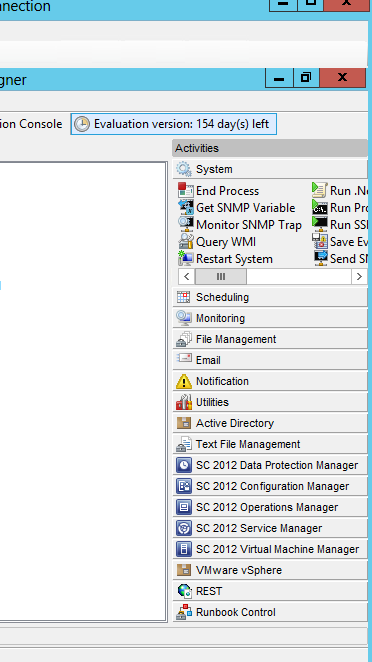
Orchestrator has a bunch of existing activities when you’re opening the runbook designer for the first time.

If you take a closer look at the picture, you will also find well-known Microsoft products and components as well as third parties. System Center 2012 has activities to each and every component, so that you can create extended functionality in your infrastructure, as well as automated tasks initiated by your users and customers, in conjunction with Service Manager’s self-service portal.


If you look closely, you can also see that I have imported an Integration Pack that integrates with VMware. But that’s another blog posts, and most likely it’s written by someone else.

Creating runbooks

Create a new Active Directory user

There are several ways to create runbooks. Some runbooks could be solely dedicated to system tasks, that runs either on a schedule, or is initiated by some system events and so on.

But if you want to create a runbook that should be presented to their users through some self-service mechanism, you would normally follow these steps:

1.       Initialize data

This activity will let you define parameters/inputs with different data types. For example, a user can specify user name, display name and other related information for a user object in Active Directory that will flow over the data bus to the next activity, which actually creates a new user based on the input in initialize data.

2.       Leveraging the activities from Active Directory Integration pack, will let you mix and match the most common tasks you would normally do manually. In this example, we will use the activity called Create User. The activity is connected to a domain controller in your environment. This is something you configure in the runbook designer itself, and also on each activity. The activities have several options related to them, and you can also add extras if you’d like. So the questions is: How can we get the data from the first activity and map them into the correct options in the next one?
 
In each option, you have the possibility to ‘subscribe’ on published data. Right click and click subscribe. This will let you map and address the data.  

3.       Enable the user is the last activity in this runbook. So once the user is created based on the input in the first activity, the account will be enabled.

Now, if you look at this runbook, you might think it’s simple, easy and not much of a hazzle to get things up and running.

However, I would like to stress that you should design your runbooks properly with some logging, alternative routes in case if an activity is failing and so on.

So let’s take a look at my second runbook.

Create a new virtual machine

We will start with the same task, initialize data. We want to combine this with a Service Offering in Service Manager, so that the users should be able to access this by themselves, with no need to access the actual management tools to perform this. (This is the beuty of self-service).

1.       Initialize data

I want my users to be able to create and deploy their virtual machines by themselves, without having the IT organization to interact each time. In addition, this must be as simple as possible, where the users have no idea of the underlying resources, or where it’s actually placed.

The only thing they should determine, is the name of the virtual machine – so that they can recognize it afterwards. 

2.       Create a VM from Template is the activity I will use. I have already create the sysprep’d VM, stored it in my library, and associated some profiles to make this magic happen.

3.       Start the Virtual Machine is the last activity, so they will be able to connect and access their resources once it’s comlpeted.

Again, a very simple runbook. But if you take a look at the data buses in this workflow, you can see I have differentiated them by using different colors. The blue ones are representing the data buses that went ok, and the red ones are related to errors.

To summarize, in case of an error during the process, the runbook will head over to the activity called ‘Send e-mail’ to notify some admins about what happen.

Hopefully, you got some ideas on how to get started with Orchestrator by now.

Use your imagination and try to start with the most boring tasks first thing first.

Next time, we’ll see how we can take this a step further with Service Manager.

Monday, October 8, 2012

System Center 2012 SP1 - Virtual Machine Manager - The Review


System Center 2012 SP1 – Virtual Machine Manager – The Review

When I was so honored to receive the MVP award in 2010, it was in the Virtual Machine Manager expertise. This component lays close to my passion for virtualization and cloud computing in general, and it’s a core component in Microsoft's cloud solutions.

I have been using Virtual Machine Manager since the 2008 version and watched the development with big enthusiasm. The launch of System Center 2012 was beyond impressive, and Service Pack 1 – that will support Windows Server 2012 (Hyper-V) will be even more stunning.

Virtual Machine Manager 2012 SP1 – what value does it bring to your business?

System Center 2012 SP1 – Virtual Machine Manager is the management layer for your infrastructure like virtualization hosts, storage, networking (pooled resources) so you can deliver cloud services to your business and customers. I believe that there’s no need to dive into all the features in Hyper-V in Windows Server 2012, because you have most likely heard a lot of them by now. The bottom line is that many organizations, independent of the size of their businesses, are looking towards Microsoft’s premium hypervisor in these days. All the known challenges and limitations from earlier versions are now addressed in this release. Multi-tenancy, VM mobility, optimization in the entire stack, and simplified management, licensing and disaster recovery to mention a few, will automatically give your ROI a solid burst.
Virtual Machine Manager is an abstraction layer above your infrastructure and you can manage those components completely from a single pane of glass.
Investments made in storage will let customers benefit from JBOD and commodity hardware in their environment by using file storage (SMB 3.0) as an alternative to block storage (iSCSI, FC) which is often associated with expensive SAN’s, switches and cables.
Virtual Machine Manager will leverage SMB and file shares (also scale-out file servers) and take care of the required configuration (no need to map permissions on individually shares and folders).
Of course, if you have invested in a SAN solution, you can leverage this from VMM as well with the support for SMI-S protocol.

To summarize the value of VMM for your fabric, VMM will support the lifecycle of your resources. All the way from bare-metal deployment of virtualization hosts by using PXE, creation of clusters, servicing and maintenance through the integration with WSUS. Needless to say, the bigger environment you got, it’s more likely that VMM will be a good friend of you.

Complexity and simplification

Network virtualization is a key feature in Hyper-V to support multi-tenancy. It’s a very powerful technique to scale your network as well, by using IP encapsulation – which is default in VMM (requires only one PA from the physical network fabric, instead of one PA for each CA if you are using IP rewrite). To configure network virtualization in Hyper-V without VMM, you must polish your kung-fu skills in Powershell. With all the respect to powershell, it’s great to configure and automate every single process in your system, but with network virtualization, it’s hard to manage a dynamic environment. And especially large environments with multiple hosts and clusters. This is where VMM comes to the playground and takes care of every bit, acting like a policy server controlling IP pools, VM networks and also routing within your environment, and also outside your network.

Beyond virtualization – and beyond private cloud

For those of you who have already played with the Beta, VMM introduces tenants in this build.

A tenant administrator can create and manage self-service users and VM networks. They can create and deploy their own VMs and services using the VMM console and a web portal.

To see the big reasons for this, we must first see the big Picture.

System Center 2012 SP1 – Orchestrator will include SPF – which is Service Provider Foundation.
This will let customers use VMM, OpsMgr and Orchestrator together in a multi-tenancy environment.

To explain this as simple as possible, you can use the SPF-activities in Orchestrator to create runbooks that will communicate with the VMM web service through OData, and use REST.
You can connect to SPF by using your own existing portal, Windows Azure Services for Windows Server and also System Center App Controller.
An interesting scenario here is when you have reached your capacity in your own private cloud, you can connect to a SPF-cloud (which could be a partner, or another cloud vendor) to increase capacity and scale to meet your needs. There might be reasons why you can’t use, or won’t use IaaS in Windows Azure for this, and that’s when this is really handy. Needless to say, App Controller will of course manage IaaS in Azure so that you can deploy virtual machines both on-premise and to the big blue cloud.

So you are interested in the best management tool for your cloud infrastructure?

-          Guess what!

System Center 2012 SP1 – Virtual Machine Manager will be the ultimate solution for you. Not only embracing the components in your own datacenter, and integrates with the other components of System Center, but it is also a framework to deliver automated and effective cloud solutions to your customers.

Wednesday, September 26, 2012

Explaining Network Virtualization with VMM part 1

Explaining Network Virtualization with VMM Part 1

Network virtualization in Windows Server 2012 is one of my favorites, because it’s just so technical and revolutionary for the entire industry.


It’s important to know that there’s several new features and options in System Center – Virtual Machine Manager 2012 SP1 – BETA related to network virtualization, so I will start to blog about it now and walk through the different configuration options.

This blog post will talk about the networking Fabric.

Fabric in VMM is a layer of abstraction above your physical and virtual infrastructure that should serve the purpose of cloud computing. Fabric will contain virtualization hosts, networks and network equipment, storage, and also some additional server roles that will maintain and support the life cycle of your fabric resources.

When you are configuring and deploying a Microsoft Private Cloud, Fabric in VMM is the place to start.
Network virtualization in VMM does also has its starting point here.
A logical network in VMM can contain several sites, subnets and VLANs that represents the physical network.

Each virtualization host must be physically connected and associated to the proper logical network before you continue with network virtualization. Check this blog post I wrote earlier about networking in VMM.

A logical network must be in place as it’s the foundation for network virtualization (CA’s and PA’S), no matter what kind of network virtualization technique you are using.

Default in SP1 is NVGRE – and not IP-rewrite as in CTP2.

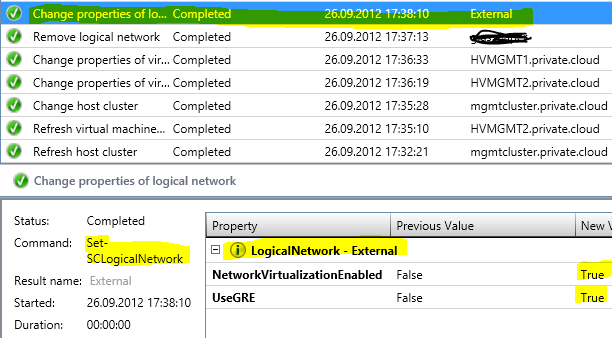
When you enable networking virtualization on the logical network, you can see the following in the jobs pane:

And during this modification you’ll find an interesting agent installed on your Hyper-V hosts:
 

More on this in the next post.

Now, let’s check what the Beta bits are bringing to the table.

Logical Switch

The Hyper-V Extensible Switch is dramatically changed in Windows Server 2012 (previously known as networks) and VMM fully supports and leverage its capabilities. An extensible virtual switch provides several options and configurations in a natively fashion, and does also supports ‘add-ons’ from thir-parties.
A logical switch is meant to represent a single configuration for you to apply to many or every hosts for a consistent configuration in your cloud infrastructure fabric.
Included in the logical switch is Native port profiles for uplink ports – used to define logical network definitions that should be available on every physical NIC connected to the logical switch.

Native port profiles for virtual ports – are used to define settings to the virtual switches that your VMs are connected to.

Port classifications – works as an identity to classify virtual port profiles for particular networks. So a VM can be deployed to different logical switches where the name matches based on the virtual port profiles on each switch.

More to come in the near future.

-kn


Monday, September 24, 2012

Windows Server 2012 Hyper-V Cookbook


I’ve been busy lately. Busy, beyond recognition.

Unfortunately, there hasn’t been enough time for my regular community activities like forums and blogging, but I will soon catch up to share some good tips and tricks from the field, since that’s where I’ve been the last months, in the field.

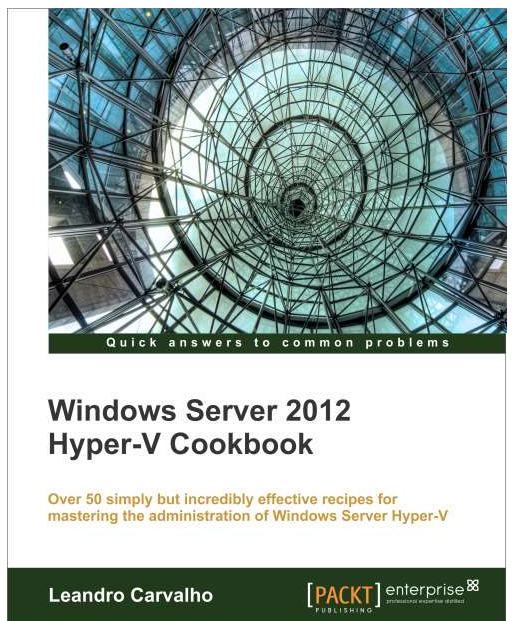
As I have announced earlier, I have been the technical reviewer on my fellow MVP – Leandro Carvalho’s book: Windows Server 2012 – Hyper-V Cookbook


It has been a really interesting project since Hyper-V is my bread and butter, laying close to my heart.
So when Leandro reached out to me for a while ago, I was lucky and grateful to accept the honor without any doubt.

The book can be ordered now, and is scheduled for December this year. This is probably the best Christmas gift you can give your IT-friends, so I would strongly recommend this one for you all.

The book is not the usual theoretical stuff you would suspect, but is straight down to business from the first page, on the very first chapter.

This is the third book I am either writing myself or participating on as a reviewer, and I must say I enjoy to read the good work from my co-authors and MVP’s. So if you are planning to write a book on related subjects and need a helping hand, feel free to contact me.

Thursday, September 13, 2012

Availability Set in System Center 2012 SP1 - Virtual Machine Manager

As you may be aware of, SP1 for System Center 2012 is now available in Beta.

The first thing I will dig into is the new features in VMM and share the good stuff with you.

First thing first is the ‘availability set’ on the hardware profile for the VMs.

Finally, we can have a deeper cluster integration with VMM and create and manage this with this premium management tool.

In other words, if you have a distributed application – or anything else that should not be located on the same cluster node, you can create an availability set.

So what does this give?

VMM have some optimization techniques like Dynamic Optimization and Power Optimization.

Especially the dynamic optimization option will be a good friend of you once you enable it, to distribute and re-balance the workloads among a Hyper-V Cluster.

If you have created an availability set, dynamic optimization will not mess up your configuration and place the VMs on the same node. Together with the option to set preferred and possible owners of virtual machines, VMM will always attempt to keep those virtual machines on separate hosts to secure uptime for your services.

This is a well-known cluster setting that we have wanted to see in VMM for a long time.

When you have created an availability set you might also be glad to know that you can also prioritize those virtual machines. When a virtual machines is defined as ‘high priority’, the cluster will then start and place those virtual machines before medium and low-priority virtual machines. Hyper-V uses values from CPU, Memory and also NUMA to give the virtual machines best possible performance compared to virtual machines defined as medium or low.
 
This is just one part of the goodie pack in SP1 for SC 2012.
More to come.

Monday, September 10, 2012

System Center 2012 SP1 Beta is now available!


Oh yes.

Finally, System Center 2012 SP1 Beta is now available and this is the version that will work together with Windows Server 2012 RTM.


Windows Server 2012 and SQL Server 2012 Support
With this Beta release, all System Center 2012 SP1 components are now enabled to manage and run in a Windows Server 2012 environment.  System Center 2012 SP1 Beta also now supports the use of SQL Server 2012. 


Network Virtualization
With System Center 2012 SP1 you can take advantage of the Virtual Machine Manager’s ability to manage Hyper-V network virtualization across multiple hosts, simplifying the creation of entire virtual networks. 


Hybrid Cloud Management and the Service Provider Foundation API
System Center 2012 already enables optimization of your organization’s private cloud and Windows Azure resources from a single pane of glass, using the AppController component. In System Center 2012 SP1 we’ve extended AppController’s capabilities to include cloud resources offered by hosting service providers, giving you the ability to integrate and manage a wide range of custom and commodity IaaS cloud services into the same single pane of glass.


Service Provider Foundation API
The Service Provider Foundation (SPF) API is a new, extensible OData REST API in System Center 2012 SP1 that enables hosters to integrate their System Center installation into their customer portal and is automatically integrated with customers’ on-premises installation of AppController. A simple exchange of credentials enables enterprises to add the Service Provider cloud to App Controller for consumption alongside private and public cloud resources. SPF also has multi-tenancy built-in enabling operation at massive scale, controlling multiple scale-units built around Virtual Machine Manager.


Windows Azure Virtual Machine management
System Center 2012 SP1 now integrates with Windows Azure Virtual Machines enabling you to move on-premises Virtual Machines to run in Windows Azure and then manage from your on-premises System Center installation enabling a range of workload distribution and remote operations scenarios


Enhanced backup and recovery options
System Center 2012 SP1 Data Protection Manager adds the option to host server backups in the Windows Azure cloud, helping to protect against data loss and corruption while integrating directly into the existing backup administration interface in System Center. More details.


Global Service Monitor Support
System Center 2012 SP1 includes support for a new Windows Azure-based service called “Global Service Monitor” (GSM). GSM extends the application monitoring capabilities in System Center 2012 SP1 using Windows Azure points of presence around the globe, giving a true reflection of end-user experience of your application. Synthetic transactions are defined and scheduled using your on-premises System Center 2012 SP1 Operations Manager console; the GSM service executes the transactions against your web-facing application and GSM reports back the results (availability, performance, functionality) to your on-premises System Center dashboard. You can integrate this perspective with other monitoring data from the same application, taking action as soon as any issues are detected in order to achieve your SLA. To evaluate System Center 2012 SP1 with GSM, sign up for the customer preview of GSM.


Begin your evaluation of System Center 2012 SP1 with Windows Server 2012 today:

I will test and play with every component, but first thing first: Virtual Machine Manager.

Oh, and you will of course not be able to Live Migrate a running VM from your private cloud to Windows Azure. You will have to store it in the library and make it accessible for Azure before you can run it in Microsoft’s cloud datacenter.

Until next time,

Kristian